Auan was born in January of 1995. When he was two years old, the calf was separated from his mother, even though he hadn’t yet been trained and hadn’t previously been vaccinated or dewormed. A nail had penetrated Auan’s foot on his left back leg. A year passed. In 1996, the owner took the elephant to the Mae Sot branch of the Livestock Office for treatment. After a month, the wound’s condition still didn’t improve. The Mae Sot Livestock Office advised the owner to administer injections for the elephant. Even then, the wound on the elephant’s foot showed no improvement. So, the owner delivered the elephant to Friends of the Asian Elephant Foundation Hospital on the 23rd of January 1997. At the time, the elephant was two years old, and he didn’t have a name. (So, the Secretary General named him.)
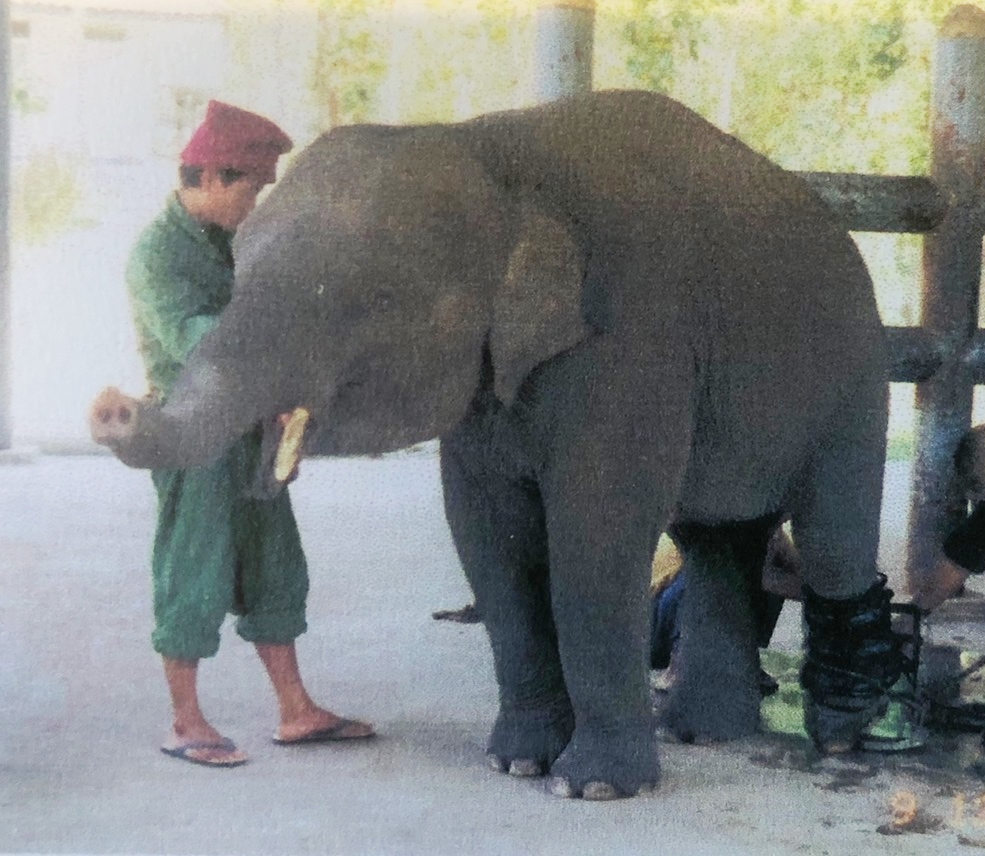
While Auan was at FAE Elephant Hospital, the foot of his left back leg from the ankle downwards suffered swollenness, with a diameter of 25 cm. The elephant could walk. But he couldn’t place his weight evenly, due the abnormal curving of his left back foot. More precisely, the foot was curving inwards. The elephant was using the side of his foot to touch the ground. The area of placement happened to be the side where the skin was thin and tender, which then resulted in wounding.
There were three wound sites on the inner side of the foot. The diameters of the wounds measured at 3 – 5 cm. The wounds were deep and exhibited continuous flows of blood and pus. These were also dirty, chronic wounds with depths that allowed the wounds to connect to each other. The extreme depths of the wounds exposed and damaged parts of the muscles and ligaments, resulting in the abnormal curving of the foot.
As for the wound site where the elephant was placing his foot on the ground, the wound was wide with a diameter of 10 cm and depth of 1.5 cm. This wound was difficult to treat due to its continuous exposure to contaminants; and the elephant was always placing his weight on the wound site.
Adjustment of the structure of the elephant’s foot:
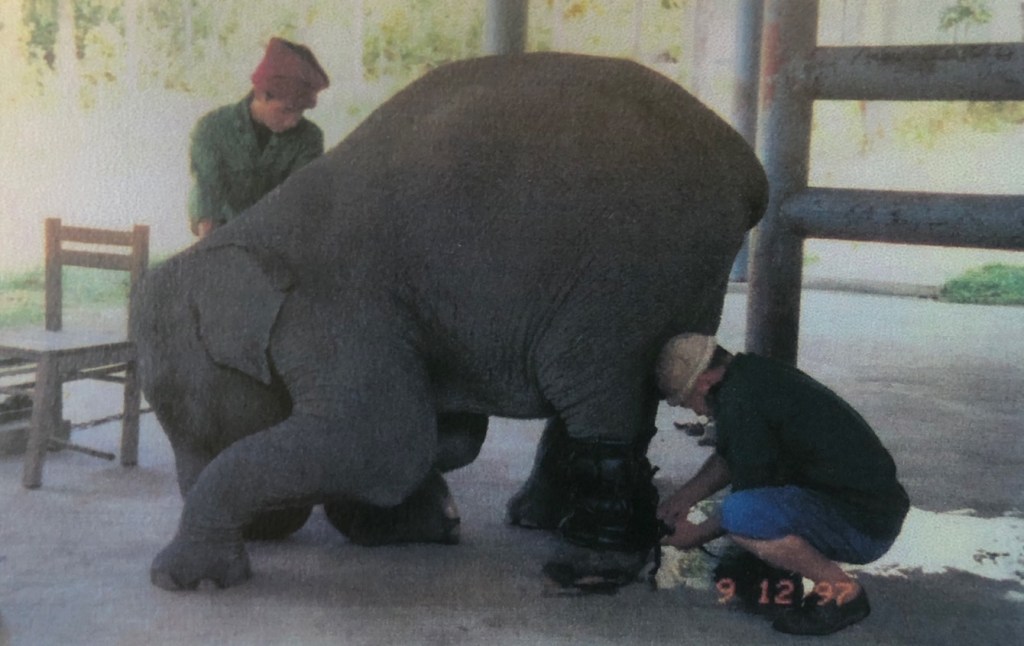
Creation of a shoe using materials from car tyres, so that the elephant could experiment and develop familiarity with wearing the shoe;
Creation of a shoe by using a metallic structure, so that the shoe’s components could be pulled and adjusted according to the realignment processes of the elephant’s foot.
For the first week, there was no improvement in the wound’s condition. For the second week, there were signs of improvement, with a reduction in the quantity of pus. For the third week, the wound dried. The elephant could completely place his weight on that foot. Pressure wounds began to reduce. But there was an area of dead flesh on the elephant’s ear, as a result of blockage of the blood flow during the administration of medications by way of the blood vessel in the ear.
The vet made a shoe for the elephant, in preparation for the bone adjustment procedures. The elephant remained in treatment at FAE Elephant Hospital until his condition improved.
On the 5th of February 2000, when Auan was six years old, the owner brought him back to FAE Elephant Hospital. (The veterinary director of the mobile veterinary unit met up with Auan, and advised for the elephant to be delivered back for treatment.) The vet performed a preliminary examination, and discovered that the elephant could be suffering from swollenness in the original wound site that had previously been treated. So, treatment was administered by daily cleansing of the wound, and dressing the wound with nitrofurazone and negasunt.
 มูลนิธิเพื่อนช้าง