ฮันนี่ ช้างป่วยรายแรกของโรงพยาบาลช้างฯที่ยังไม่ได้สร้าง
Honey: FAE’s first patient treated before the elephant hospital was set up
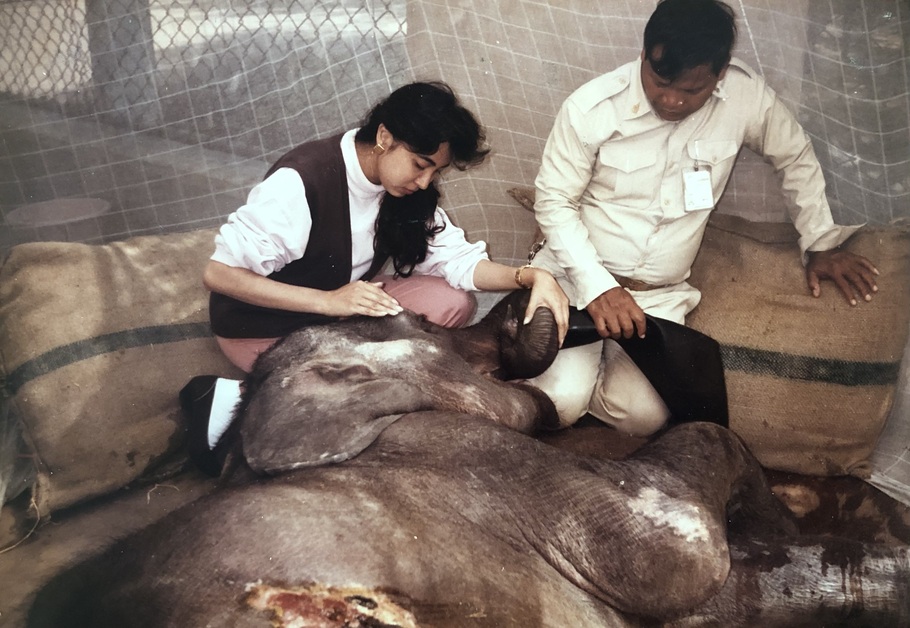
“ฮันนี่” ช้างเพศเมีย (เป็นช้างแสดง ในคณะแสดงช้างที่เดินทางไปยังที่ต่างๆ) ซึ่งได้รับอุบัติเหตุถูกรถบรรทุกหกล้อชนที่ จ.ลำพูน ตั้งแต่วันที่ 3 พฤศจิกายน 2536 เจ้าของคือ นายมานะ ไตรยศ ได้นำฮันนี่มาพบคุณหมอปรีชา พวงคำ ที่ จ.ลำปาง ในคืนวันที่ 10 พฤศจิกายน 2536
“Honey”, a female elephant (a performing elephant that was part of a travelling group), was a victim of an accident. She was hit by a six-wheel truck in Lamphun Province on the 3rd of November 1993. Her owner, Mana Traiyot, delivered Honey to Dr. Preecha Phougkum in Lampang Province on the 10th of November 1993.
มูลนิธิเพื่อนช้าง ได้รับเป็นเจ้าของไข้ช้างน้อยฮันนี่ในทันที ซึ่งข้อวินิจฉัยเบื้องต้นคือ กระดูกเชิงกรานหัก แต่เนื่องจากโครงการโรงพยาบาลช้างฯ ยังอยู่ระหว่างออกแบบและจัดหาทุนทรัพย์
คุณโซไรดา ซาลวาลา ผู้ก่อตั้ง/กรรมการและเลขาธิการจึงประสานงานกับคณะสัตวแพทยศาสตร์ จุฬาลงกรณ์มหาวิทยาลัย แต่เนื่องจากไม่มีพื้นที่ให้พัก จึงขอนำฮันนี่มาพักรักษาตัวที่สวนสัตว์ดุสิต โดยมูลนิธิฯเป็นผู้รับภาระค่าใช้จ่ายทั้งหมด เมื่อประชาชนทราบข่าวความเมตตาก็หลั่งไหลมาสู่ช้างน้อยฮันนี่เป็นอย่างมาก
Friends of the Asian Elephant Foundation immediately accepted Honey for treatment. According to the preliminary diagnosis, the elephant had suffered damages in the area of the pelvic bone structure. At the time, FAE Elephant Hospital was in the design and planning stage, and funding was still being organised. Soraida Salwala, Founder, Secretary General and Board of Committees, liaised with the Faculty of Veterinary Medicine of Chulalongkorn University. Since there was no location that could serve as Honey’s site of accommodation, a request was submitted to deliver the elephant to Dusit Zoo where she could continue resting. The Foundation took on the responsibility of bearing all the expenses involved in Honey’s care and treatment. When news of Honey’s condition reached the public, expressions of kindness streamed through in great abundance.
คณะแพทย์ดูแลรักษาฮันนี่ด้วยการฉีดยาแก้ปวด ยาลดอักเสบและยาปฏิชีวนะ แพทย์ได้ทดสอบสมรรถภาพของขาหลังสองข้าง ด้วยการนำฮันนี่ขึ้นรอกขนาดเล็ก แต่มีกดทับบริเวณหน้าอก จึงต้องรีบปลดรอกออก ต่อมาได้มีการพยายามใช้รอกขนาดใหญ่ แต่ไม่สำเร็จ จึงต้องให้พักอยู่ในท่านอนตลอดสองสัปดาห์แรก เมื่อฮันนี่พยายามขยับตัว เสียงร้องด้วยความเจ็บปวดจะดังสนั่นไปทั้งบริเวณสวนสัตว์ การนอนท่าเดียวนานๆ ทำให้เกิดแผลกดทับขึ้นทางส่วนท้ายลำตัวของฮันนี่
The veterinary team treated Honey by administering injections of pain relief, anti-inflammatory medications and antibiotics. The vets tested the capacity of the elephant’s back legs by supporting Honey with a small pulley. But it turned out that the belts attached to the pulley were pressing onto the elephant’s chest. So, the pulley had to be loosened and removed. In times that followed, there was an attempt to use a large pulley, but without success. So, the elephant had to rest in a lying down position during the first two weeks. Every time Honey tried to move, her loud roars and cries would be heard all over the zoo facility. Lying down in the same position for extended periods of time caused pressure wounds towards the back part of the elephant’s body.
ความทราบถึงสมเด็จพระนางเจ้าฯพระบรมราชินีนาถได้รับพระมหากรุณาธิคุณโปรดเกล้าฯ ให้ราชเลขานุการในพระองค์ ขอความร่วมมือจากการท่าเรือแห่งประเทศไทย นำรถยกสองคันพร้อมด้วยเจ้าหน้าที่ตามที่ทางมูลนิธิฯร้องขอ โดยเลขาธิการมูลนิธิเพื่อนช้างเดินทางไปยังการท่าเรือฯ เพื่อเลือกรถและอุปกรณ์ด้วยตัวเอง
News reached Her Majesty Queen Sirikit who assigned her private secretary to coordinate with the Port Authority of Thailand. Two trucks designed for lifting purposes were delivered along with personnel, according to the Foundation’s request. The Secretary General of Friends of the Asian Elephant Foundation travelled to the port to select the trucks and the equipment for incorporation into the lifting duties.
ต่อมา ศ.น.สพ. ม.ร.ว. ชนาญวัต เทวกุล ที่ปรึกษาอาวุโส ได้ขอตัวควาญช้างหลวง นายรมย์ ยวงทอง เพื่อเฝ้าบำบัดและบริบาลช้างน้อย
At a later stage, Professor Dr. MR Chananwat Devakula, senior consultant, requested for Rom Yuangthong, mahout of the Royal Elephant Stables, to supervise therapy and care for the young elephant.
ราวปลายเดือนพฤศจิกายน ผู้บริบาลสามารถพยุงฮันนี่ยืนสลับการนอนได้เป็นระยะๆ ต่อมาได้ทำการเอกซเรย์สองขาหลังฮันนี่ โดยได้รับความช่วยเหลือจากโรงพยาบาลพระมงกุฎฯ ปรากฎว่า ขาหลังทั้งสองข้างไม่มีการแตกหัก แต่น่าเสียดาย ฟิล์มที่ถ่ายกระดูกสะโพกและหลัง ไม่ปรากฎภาพ สันนิษฐานว่ากล้ามเนื้อบริเวณนั้นมีความหนาแน่นมากจนเอกซเรย์ไม่ผ่าน
In late November, the keeper could support Honey while the elephant alternated between standing and lying down from time to time. An x-ray was performed for Honey’s back legs, with assistance from Phramongkutklao Hospital. The results showed that there were no cracks and damages to the elephant’s back legs. But it is a pity that no images appeared on the film x-ray for the bones of the hip and back. It was assumed that the muscles in those areas were so thick, causing the x-ray’s failure to capture the images.
วันที่ 16 ธันวาคม 2536 เจ้าของช้างฮันนี่ ได้ทำหนังสือยกช้างให้กับคุณโซไรดา ซาลวาลา
On the 16th of December 1993, Honey’s owner signed the paperwork to transfer ownership to Soraida Salwala.
กลางเดือนธันวาคม ร่างกายของช้างน้อยไม่สามารถควบคุมระบบขับถ่ายปัสสาวะได้ ปัสสาวะเริ่มมีหนองปนเปื้อน เนื่องจากมีการติดเชื้อและกระเพาะปัสสาวะอักเสบ
In mid-December, the young elephant’s body could no longer control the urinary functions. Pus could be observed mixed in with the elephant’s urine, due to infections and inflammation in the urinary system.
สองเดือนผ่านไป อาการของฮันนี่ทรุดหนักลงในช่วงใกล้สิ้นปีนั้นเอง ฮันนี่เริ่มกินอาหารน้อยลง ผ่ายผอม ปัสสาวะรั่วซึมออกทางผิวหนังตลอดเวลา
After two months, which was nearing the end of that year, Honey’s condition worsened. The elephant began eating less and less. She was thin. And her urine was constantly leaking out from her skin.
บริเวณส่วนท้ายเป็นแผลลึกเปิดกว้าง ช้างน้อยทรมานอย่างเวทนา
Towards her back end, there was a deep open wound. The young elephant was in a state of extreme suffering.
ต่อมาอีกเดือนเศษ ฮันนี่เริ่มอ่อนแรงและมีอาการติดเชื้อสู่กระแสเลือด นับตั้งแต่วันที่ 10 กุมภาพันธ์เป็นต้นมา การตอบรับของประสาททั้งหมดหยุดการทำงาน ขาเริ่มบวม
Over the course of just over a month that followed, Honey grew even weaker. Her bloodstream had contracted an infection. From the 10th of February onwards, her senses stopped responding. Her legs became swollen.
กลางดึกของวันที่ 15 ข้ามสู่วันที่ 16 กุมภาพันธ์ ฮันนี่หมดลม และหยุดความทรมานยาวนานกว่าสามเดือนในเวลา 00.10 น.
In the middle of the night of the 15th, going on to the 16th of February, Honey passed away. Her suffering that had lasted longer than three months came to an end at 00.10.
คณะสัตวแพทยศาสตร์ จุฬาลงกรณ์มหาวิทยาลัยได้ทำผ่าชันสูตรซากฮันนี่ เมื่อวันที่
16 กุมภาพันธ์ 2537 ได้ผลสรุป
A surgical procedure was performed to thoroughly examine Honey’s corpse. The autopsy was carried out by the Faculty of Veterinary Medicine of Chulalongkorn University. On the 16th of February 1994, the autopsy to determine the cause and manner of death revealed the following results.
สาเหตุการตายของฮันนี่ว่า “กระดูกเชิงกราน ด้านขวา เบ้าหัวกระดูกต้นขาแตกร้าว กระดูกสันหลังตอนท้ายของส่วนอกได้รับการกระทบกระแทกแตกหักกดทำลายไขสันหลังเสียหาย เป็นอัมพาตเคลื่อนไหวไม่ได้ เกิดแผลกดทับบริเวณกว้างหลายจุด เกิดการติดเชื้อแทรกซ้อนเข้าสู่ช่องท้องและช่องอกอักเสบ โลหิตเป็นพิษและเสียชีวิตในที่สุด
The cause of death was due to the damage suffered by the top part of Honey’s leg on the right side of her pelvic bone structure. As for the vertebrae on the back part of the elephant’s chest, the injury suffered in that area also damaged the spinal cord in the process. The elephant was paralysed as a result. There were many sites of wide pressure wounds. The abdominal area and the inflamed chest area contracted infections. The elephant suffered blood poisoning, and finally passed away.
คุณโซไรดา ซาลวาลา ในฐานะเจ้าของช้างฮันนี่ ได้มอบโครงกระดูกให้กับคณะสัตวแพทย์ จุฬาลงกรณ์มหาวิทยาลัย เพื่อประโยชน์ทางการศึกษา และได้ทำพิธีบำเพ็ญกุศล และนำซากช้างน้อยไปทำการเผา ณ ฌาปนสถาน วัดเสมียนนารี ในวันที่ 18 กุมพาพันธ์ 2537 และนำเถ้าไปลอย ณ ปากอ่าวไทย ในวันรุ่งขึ้น
Soraida Salwala, as Honey’s owner, donated the elephant’s skeleton to the Faculty of Veterinary Medicine of Chulalongkorn University to use for educational purposes. A merit-making ceremony was performed as part of Honey’s memorial service. The young elephant’s remains were cremated at Wat Samian Naree temple on the 18th of February 1994. Her ashes were floated away at the mouth of the Gulf of Thailand the following day.
 มูลนิธิเพื่อนช้าง